
Research
© Copyright. All rights reserved
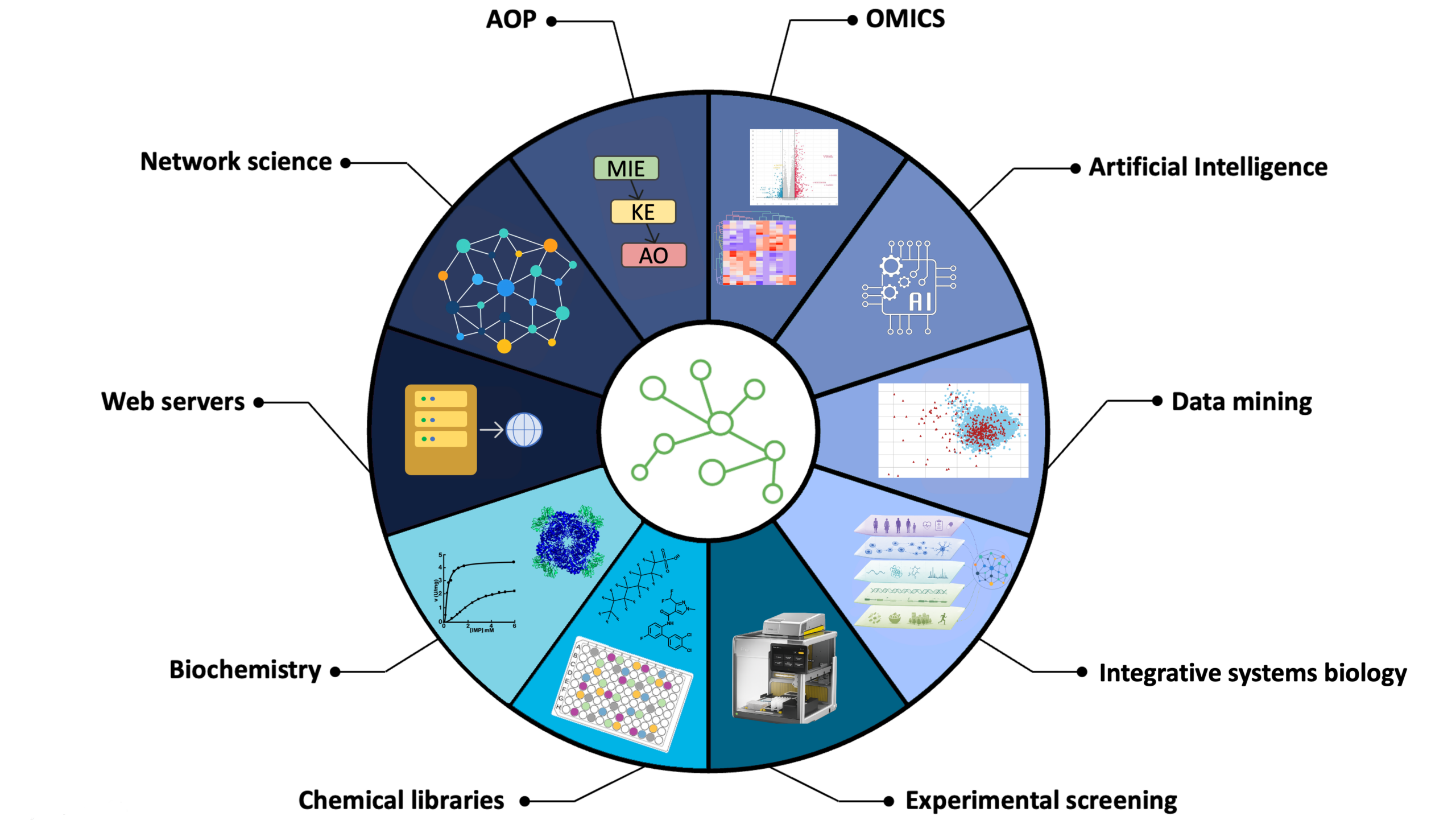
Our CompTox research integrates network science, systems biology, artificial intelligence, and chemoinformatics to investigate the complex relationships between the exposome and human health. We develop innovative computational methods and web-based platforms, including AOP-helpFinder and ReadEDTest, to advance toxicological research through data integration, data mining, classification, and clustering approaches. Our work focuses on the analysis of large-scale multi-omics datasets, including transcriptomics, metabolomics, proteomics, and exposomics, to build predictive models of toxicity and disease.
By combining natural language processing and text mining strategies, we identify events to generate novel Adverse Outcome Pathways (AOPs), contributing to next-generation predictive toxicology and exposome science.
Our BiochemTox research pursues a dual mission: exploring complex biological pathways using small molecules as probes (chemical biology) and unraveling how compounds from the chemical exposome (such as organic pollutants) interact with their targets (mechanistic toxicology). Our experimental approach combines the production and purification of key protein targets with high-throughput screening against diverse chemical libraries. Using tailored activity and binding assays then allow us to describe the biological effects and molecular interactions of these molecules.
Current projects
PARC (2022-2029): Horizon Europe
The European Partnership for the Assessment of Risks from Chemicals aims to develop next-generation chemical risk assessment to protect human health and the environment. It supports the European Union’s Chemicals Strategy for Sustainability and the European Green Deal’s “Zero pollution” ambition.

CAPSTONE (2025-2029): COST action
This project aims to identify pesticide-induced adverse effects related to oxidative stress that are relevant to both human health and ecosystems, within the One Health framework. It will develop an innovative research strategy based on Adverse Outcome Pathways (AOPs) through a pan-European, interdisciplinary network bringing together scientists, regulators, and stakeholders. The outcomes will support risk assessment and policymaking, in synergy with existing international initiatives.
SIRENE (2026-2030): Horizon IFRA
The SIRENE project (Services for envIRonmental Exposure and health assessmeNt in Europe) is a Horizon Europe initiative dedicated to advancing our understanding of how environmental factors affect human health throughout life. SIRENE supports the development of exposome research and environmental health assessment across Europe.

GEmet (2025-2026): UPC
The project proposes to develop and apply a new method for studying the interactions between environmental exposure and genetic risk factors, at the intersection of large-scale genetic studies and studies of the impact of environmental factors, focusing on metabolic diseases. The project is based on the development of a method for extracting environmental risks coupled with the advancement of new methods for analyzing interactions and the availability and accessibility of large databases.

Exposome Booster Program (2024-2026): Inserm WP2
This Booster program combines multiple approaches to identify associations between components of the exposome and health events at multiple scales but also to better define causal links between them.

ScoreDockPolariz (2022-2027): ANR
ANR project to develop a novel accurate empirical scoring function for virtual screening and drug discovery. In vitro screening will also be applied on both catalytic and PPI sites to cross-validate the in silico predictions and to identify new valuable small molecules.

FUSION (2024-2026): ANR PRCI
ANR/DFG collaborative Franco-german project that focus on SDHi (succinate dehydrogenase inhibitors), a family of fungicides. The overall objective is to fill a large gap of knowledge regarding the neurodevelopemental toxicity of SHDi fungicides using an integrated approach and several complementary in vivo, in vitro and in silico (AOP development) models.
ENDOFAT (2024-2028): ANR
The ENDOFAT project will study the interactions between xenobiotics, adipose tissue and endometriotic lesions using an integrative approach.
Platforms
ELIXIR Toxicology
The ELIXIR Toxicology community is co-leaded by SysTox (K. Audouze). The main goal is to support the integration of standards, tools and resources to support toxicology research projects and risk governance at the national and international levels.

France Exposome
France Exposome supports research in the environmental health field, leading to a better understanding of the existing associations between chemical exposures and health outcomes related to chronic diseases.

Past projects

CREATIvE (2019-2023): ANR

INTOXICOM (2023-2025): EU-ELIXIR
Integrating the Toxicology Community into ELIXIR

IA-COPc (2024-2025): Cancérôple IdF
Artificial intelligence to assess the impact of the chemical exposome on breast cancer and its societal cost: towards an integrated and interdisciplinary approach for public health.
HBM4EU (2017-2021): H2020
HBM4EU: H2020 project with the aim of coordinating and advancing human biomonitoring in Europe to provide evidence for chemical policy making.

RadoNorm (2020-2025): H2020
RadoNorm: H2020 project – Towards effective radiation protection based on improved scientific evidence and social considerations – focus on Radon and NORM

HERA (2019-2021): H2020 CSA
HERA : H2020 project – The overall aim of the HERA project is to set the priorities for an envionment, climate and health reserach agenda in the EU.

ReadEDTest (2022): PEPPER
A self-questionnaire to enable researchers to assess the status of their in vitro test for endocrine disruptors.

MULTIMIX (2018-2023): ANR
MULTIMIX: ANR project – Multidisciplinary approach to better understand aroma perception of flavor mixture.

Neurophyto (2021-2023): French EcoPhyto
Ecophyto II+ plan : Study of the effects from exposure to agrochemicals on the cognitive and psychomotor development of children.

TABAhR (2019-2020): INCa
INCa et IRESP project: Co-exposure to cigarette smoke and tumor microenvironment & breast cancer aggressiveness.